What Is Pure Straight in Mahjong? Building the Beautiful 2-Han Yaku
Published Updated

Among the various yaku (yaku) in mahjong, mahjong Pure Straight is especially popular for its visually striking tile arrangement. Often called "ittsu", the satisfying sight of numbers 1 through 9 lining up in orderly fashion is a major highlight even for beginners just learning mahjong.
By understanding its basic shape correctly and mastering the conditions required to complete it, you will be able to quickly judge whether to aim for it right from your starting hand. Let us begin by reviewing the standard tile combinations.
Basic Shape and Completion Requirements of Pure Straight
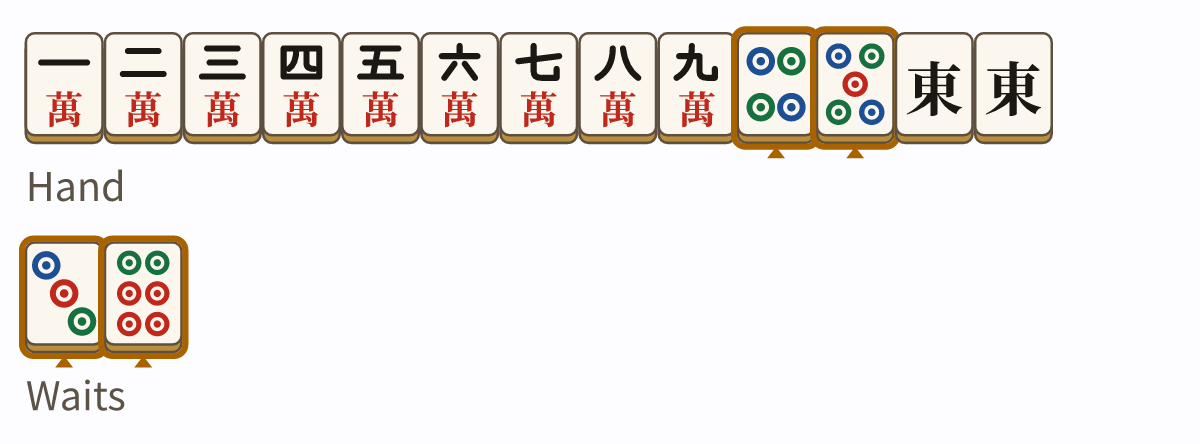
Figure 1 as text
Hand: 1m 2m 3m 4m 5m 6m 7m 8m 9m 4p 5p East East
Waits: 3p, 6p
Highlighted tiles: 4p, 5p
Notation: 123456789m45p11z
In this diagram, the sequences (sets of 3 consecutive numbers) from 1 characters to 9 characters are assembled, showing a closed Pure Straight shape waiting to win on either 3 circles or 6 circles. Pure Straight is a yaku formed by completing 3 sets (melds of 3 tiles)—"123", "456", and "789"—in the same suit.
3 circles and 6 circles in the diagram are wait tiles, and getting either results in a win (completing the hand to win). The most essential point when aiming for this yaku is that it must be split into blocks of 3 tiles: "123", "456", and "789". For example, even if the sequence "123456789" itself is present, if the sets split into "234", "567", and so on, it will not count, so be careful.
Pure Straight is worth 2 han (han) if your hand remains closed without calling from others. Furthermore, if you reach ready hand (tenpai) while closed, you can declare riichi (riichi), naturally bringing high scores like mangan within reach.
Changes When Calling and Deciding When to Open
Figure 2 as text
Hand: 2m 3m 4m 1p 1p 1s 2s 3s 4s 6s
Chi (from left): 7s 8s 9s
Waits: 5s
Highlighted tiles: 4s, 6s
Notation: 234m11p12346s chi 789s
In this diagram, the player has called chii on 7 bamboo from the player on the left to complete the 7 bamboo, 8 bamboo, 9 bamboo sequence. Pure Straight can still be completed after calling chii, but the rule of kuisagari applies, reducing its value from 2 han to 1 han.
In the diagram, 5 bamboo is the final wait tile in a middle-tile wait. Calling speeds up your hand, but it reduces your han value and leaves fewer tiles in hand to defend safely against riichi from other players. Therefore, whether to open your hand for a 1-han Pure Straight requires careful assessment.
Good benchmarks for calling into Pure Straight include already having a pair of yakuhai (dragons or seat/prevalent wind) to ensure score value, or holding red 5s or dora so that the hand scores well even at 1 han. Calling to prioritize speed is also useful late in an East-only game when you need an urgent win.
Play in the app
The quickest way to absorb what you've read is to try it at the table. Play against computer opponents on your own, at your own pace, anytime and anywhere.


Scan with your phone to open the store
Free to play. Contains ads. No in-app purchases.
Maintaining Flexible Tile Acceptance Without Forcing It
Because Pure Straight has an easily recognizable shape, having many terminal tiles in the same suit at the start can tempt players to force it. However, completing a Pure Straight in mahjong requires gathering 9 specific numbers in precise sequence; if opponents hold the tiles you need, your hand can easily stall.
Keeping the following points in mind helps you build a smooth, flexible playing style when deciding whether to pursue it.
- Prioritize wide tile acceptance: When middle tiles (3 to 7) overlap, consider transitioning toward All Simples or Pinfu rather than forcing 1 and 9 to stay in hand.
- Do not cling to edge waits: Holding "12" or "89" leaves only 1 kind of tile to draw, so have the courage to discard them cleanly when you draw tiles that create wider two-sided waits.
- Compare with other 2-han yaku: Other 2-han yaku include All Triplets and Outside Hand. Adjust your target flexibly based on tile pairs and remaining terminal tiles.
To hone these decisions in real games, practicing in a relaxed solo setting against computer opponents like Jankokushi, where you can observe tile acceptance without turn timers, is highly effective.
Summary of Pure Straight Characteristics and Rules

Finally, let us organize the key traits and rules of Pure Straight. Keeping its combinations with other yaku and han shifts in mind will reduce hesitation during real games.
| Item | Details |
|---|---|
| Han value | 2 han closed, 1 han if open (kuisagari) |
| Hand composition | Complete "123", "456", and "789" sequences in the same suit |
| Compatible yaku | Riichi, Pinfu, Half Flush, Yakuhai |
| When to aim | Holding 6 or more tiles of the same suit early with clear block outlines |
Ittsu is a dependable yaku (yaku) that can produce a high score all at once when combined in a closed hand with riichi (riichi) or pinfu. On the other hand, if you fixate on it so much that you narrow your acceptance of middle numbers, you will stray further from a win. Discern when you can aim for it naturally according to the flow of your hand, and aim for a brilliant win.
When you want to test yaku development and calling decisions in real games, try playing the offline solo mahjong game Jankokushi: A Mahjong March to verify tile combinations at your leisure.
Frequently asked questions
Does Pure Straight still count as a yaku if you call tiles?
Yes, it does. However, kuisagari applies, reducing its value from 2 han closed to 1 han.
Does having 1 through 9 in the same suit always make Pure Straight?
No, it must divide cleanly into the three distinct sequences "123", "456", and "789". If your sets divide into "234" and "567", it does not count.
Can Pure Straight combine with Pinfu?
Yes, they can combine. If your hand is closed with a non-yakuhai pair and a two-sided wait, the requirements for Pinfu are met and both yaku are scored together.
Play in the app
Why not sit down at the tables with Three Kingdoms figures and test your yaku and riichi in the mahjong RPG Jankokushi as you march across the land?
Scan with your phone to open the store
Free to play. Contains ads. No in-app purchases.